

Roulette academy
Learn roulette from the wheel up
Roulette is easy to start and surprisingly deep once you get into the maths, wheel layouts, French rules, bet types and different ways games are presented online. This guide brings the whole subject together in one place. You can use it from top to bottom as a course, or jump straight to the part you need and follow the specialist links when you want more detail.
Roulette explained in 60 seconds
A roulette wheel contains numbered pockets. You place chips on a betting layout before the spin, the dealer or software spins the wheel and ball, and the winning number determines which bets are paid. That is the whole game in its simplest form.
| Version | Wheel | Standard house edge | Best even-money edge |
|---|---|---|---|
| European | 37 pockets: 0–36 | 2.70% | 2.70% |
| French | 37 pockets: 0–36 | 2.70% | 1.35% where la partage or qualifying en prison rules apply |
| American | 38 pockets: 0, 00, 1–36 | 5.26% on most bets | 5.26% |
If you only remember one table-choice rule, make it this: a single-zero European wheel is normally better value than a double-zero American wheel. A French table with la partage on even-money bets can improve the maths again.
Anatomy of a roulette game
The wheel and betting table are two views of the same numbers, but they are arranged differently. The betting layout runs the numbers in a grid so chips can cover combinations cleanly. The wheel uses a deliberately mixed numerical order around the rim. Knowing the difference makes the game much easier to read.
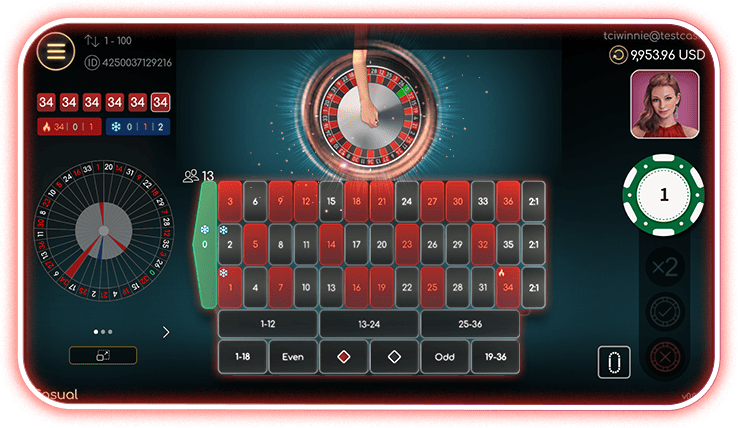
The physical or simulated wheel contains 37 pockets on a European/French game and 38 on a standard American game.
The grid lets you cover single numbers, adjacent numbers, rows, columns and larger outside groups.
Chip value controls your stake. The position of the chip determines the bet you are making.
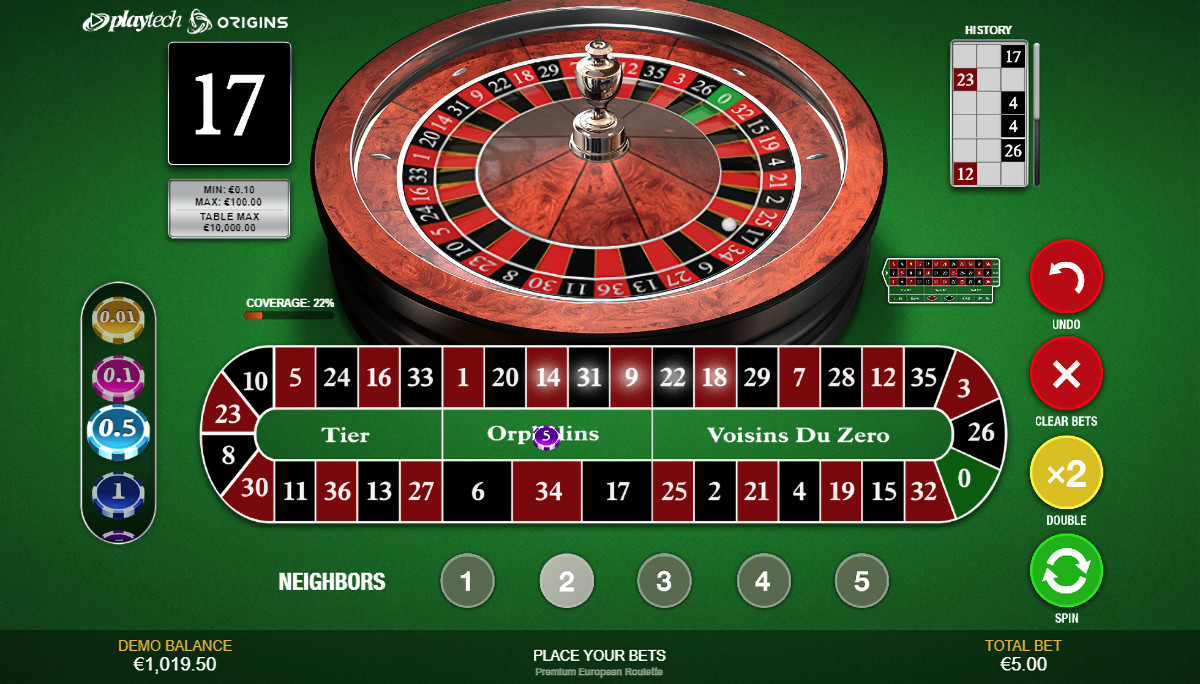
Our roulette wheel and table guide goes deeper into wheel order, racetrack layouts and the differences between single-zero and double-zero wheels.
European, French and American roulette compared
The three classic versions share the same basic game, but the extra zero on an American wheel and the player-friendly rules found on some French tables change the expected return. These differences matter more than cosmetic themes or the colour of the table.

The key is not that American roulette is harder to understand. It is that the payout table does not compensate you for the extra 00. A straight-up bet still pays 35:1 even though you are now picking one number from 38 rather than one from 37.
What the house edge actually means
The house edge is a long-run expectation, not a prediction of what will happen in your next ten spins. A 2.70% edge means that, averaged across a very large amount of action under the same rules, the casino retains about 2.70 units for every 100 units wagered. Your actual session can finish well above or below that figure because roulette is volatile in the short term.
| Example: £1,000 total wagered | Theoretical casino advantage |
|---|---|
| French even-money bet with la partage | £13.50 |
| European roulette standard bet | £27.00 |
| American roulette standard bet | £52.60 |
That comparison is why table selection matters. Changing from American to European roulette genuinely changes the underlying maths. Changing from red to black does not. Our roulette odds guide breaks down the probability calculations in more detail.
Roulette payouts and probabilities
Most standard European roulette bets share the same 2.70% house edge. What changes is how many numbers you cover, how often you can expect a winning outcome and how much the game pays when one lands.
| Bet | Numbers covered | Payout | European win probability | Standard edge |
|---|---|---|---|---|
| Straight up | 1 | 35:1 | 2.70% | 2.70% |
| Split | 2 | 17:1 | 5.41% | 2.70% |
| Street / trio | 3 | 11:1 | 8.11% | 2.70% |
| Corner | 4 | 8:1 | 10.81% | 2.70% |
| Six line | 6 | 5:1 | 16.22% | 2.70% |
| Dozen | 12 | 2:1 | 32.43% | 2.70% |
| Column | 12 | 2:1 | 32.43% | 2.70% |
| Red / black | 18 | 1:1 | 48.65% | 2.70% |
| Odd / even | 18 | 1:1 | 48.65% | 2.70% |
| 1–18 / 19–36 | 18 | 1:1 | 48.65% | 2.70% |
American roulette uses the same standard payouts but divides the wheel across 38 pockets, so the probabilities are slightly lower. One bet needs special attention: the American five-number basket on 0, 00, 1, 2 and 3 pays 6:1 and carries a 7.89% house edge, worse than the normal 5.26% American edge.
If you want chip-placement diagrams and the full catalogue of inside, outside and named bets, use our roulette bets guide. This academy keeps the reference maths here without repeating every specialist betting pattern.
Inside bets vs outside bets
Inside bets
These sit on the numbered grid and usually cover one to six numbers. They win less often but pay more when they hit.
Think: straight, split, street, corner and six line.
Outside bets
These cover larger groups of numbers. They hit more frequently, but payouts are smaller.
Think: red/black, odd/even, high/low, dozens and columns.
A higher hit rate does not automatically mean better value. On a normal European wheel, a straight-up bet and a red/black bet both carry the same 2.70% house edge. They simply produce very different short-term experiences.
La partage and en prison
These are two of the most useful rules to recognise because they can genuinely change the expected loss on even-money bets. They normally apply to red/black, odd/even and 1–18/19–36 on a single-zero wheel.
La partage
You stake £10 on red. Zero lands. Instead of losing the full £10, the stake is split: £5 is returned and £5 is lost.
Because zero costs only half a stake, the house edge on qualifying even-money bets falls from 2.70% to 1.35%.
En prison
When zero lands, a qualifying even-money stake is held rather than immediately settled. Under the common French form, a win on the next resolving spin releases the original stake without profit; a loss loses it.
Exact handling of repeated zeros can vary by ruleset, so check the table’s help panel rather than assuming every en prison game is implemented identically.
Under standard player-friendly implementations, these rules bring the expected loss on qualifying even-money bets to about 1.35%. They do not improve inside bets, dozens or columns.
How to play a round of roulette
- Choose your version. Start with the wheel rules, not the graphics. Single-zero is normally preferable to double-zero.
- Select a chip value. Online games usually offer a row of chip denominations; live tables also show table minimums and maximums.
- Place your bets. Put chips directly on a number or on the line/area that represents a combination.
- Check the total stake. Several small chips can add up quickly when you cover multiple numbers.
- Betting closes. On live roulette the dealer announces this before the ball settles. RNG games may close immediately when you press spin.
- Settle the result. Losing chips are removed and winning bets are paid automatically online.
If you are completely new, the full how-to-play roulette guide walks through the table controls and betting process in more detail.
How roulette wheels are laid out
Roulette numbers are not arranged sequentially around the wheel. The order is designed to spread high/low, odd/even and red/black numbers around the rim. European and American wheels use different sequences, and that matters when you use neighbour or racetrack bets because those bets follow physical wheel position rather than the rectangular number grid.
A European wheel has one green zero. An American wheel normally has two green pockets, 0 and 00. The extra pocket is the simple reason most American bets have a higher edge. For wheel sequences, racetrack sectors and neighbour diagrams, use the dedicated roulette wheel and table guide.
Roulette odds without the maths headache
The quickest way to work out the chance of a roulette bet winning is to divide the number of winning pockets by the total pockets on the wheel.
| Example | Calculation | Probability |
|---|---|---|
| European straight-up number | 1 ÷ 37 | 2.70% |
| European red | 18 ÷ 37 | 48.65% |
| European dozen | 12 ÷ 37 | 32.43% |
| American red | 18 ÷ 38 | 47.37% |
The payout is not the same thing as the probability. A straight-up number pays 35:1 because it is much less likely to hit than an even-money bet. The zero pocket is what stops the payout schedule being mathematically fair to the player. For deeper probability tables and expected-value examples, continue to roulette odds.
Bankroll basics
Bankroll management cannot change the house edge, but it can change how quickly you expose your money to normal roulette variance. The useful question is not “what stake will win?” but “how much of my session bankroll am I putting at risk each spin?”
| £100 session bankroll | Number of 1-unit bets the bankroll can cover |
|---|---|
| £1 unit | 100 |
| £2 unit | 50 |
| £5 unit | 20 |
| £10 unit | 10 |
This does not mean you should plan to play a fixed number of spins. It shows the relationship between stake size and how much room you have for losing runs. Decide what you can afford to spend before the session, keep that separate from day-to-day money and do not increase the bankroll simply because a run has gone badly. Our responsible gambling guide covers spending limits and safer-play controls in more detail.
Do roulette betting systems work?
A betting system can tell you how much to stake next. It cannot make a fair roulette wheel remember the previous spin or remove the zero from the game. That distinction is the starting point for evaluating Martingale, Fibonacci, D’Alembert and every other progression.
| Approach | Basic idea | What changes | What does not change |
|---|---|---|---|
| Flat betting | Keep the same unit size | Stake remains consistent | Wheel probability and house edge |
| Martingale | Increase after losses | Stake size and bankroll exposure | Wheel probability and house edge |
| Fibonacci | Move through a number sequence after losses | Progression pattern | Wheel probability and house edge |
| D’Alembert | Add or subtract one unit after results | Progression speed | Wheel probability and house edge |
The specialist roulette strategy and betting systems guide is where we compare the systems properly, including bankroll pressure, table-limit risk and the way different progressions behave during losing runs.
Five roulette myths worth dropping
Not on an independent fair spin. The previous result does not change the next wheel probability.
Not on a standard European table. They win more often but pay less.
It changes stake size. The wheel and payout maths stay the same.
It raises hit frequency, but you also stake more or accept smaller payouts.
History screens are useful records, not forecasting tools.
RNG roulette vs live roulette
| RNG roulette | Live roulette | |
|---|---|---|
| Outcome | Generated by certified game software/RNG | Physical wheel spun in a studio or casino |
| Dealer | No live dealer | Live croupier/presenter |
| Pace | Often self-paced or faster | Controlled by the dealer and betting timer |
| Presentation | Fully digital | Video stream with digital betting interface |
| Rules | Can be European, American or feature-led | Can also be European, American or feature-led |
Live presentation does not automatically improve or worsen the odds. The wheel format, payouts and special rules are what determine the maths. You can browse our informational live roulette hub if you want to compare streamed formats.
Live roulette etiquette
Online live roulette is less formal than a physical casino, but a few habits make the table easier to use. Place bets before the countdown closes, do not expect the dealer to change a wager after “no more bets”, keep chat respectful and check the table limits before building a complicated spread of chips.
If you use racetrack or neighbour controls, learn what the button is going to place before you tap it. A single click can place several individual chips. At a land-based table, remember that roulette colour chips can be player-specific, so the value is set at the table rather than printed like a normal casino chip.
Online roulette controls worth understanding
Repeats the previous layout. Check the total before confirming.
Doubles the chips currently on the table. It also doubles the amount at risk.
Removes the most recent chip or action before the spin.
Removes all unconfirmed bets so you can rebuild the layout.
Places bets by physical wheel sectors rather than table-grid position.
Shows previous outcomes. Useful for records, not for predicting independent spins.
Classic and modern roulette variants
Modern roulette games often keep the familiar wheel but change the presentation or add side features. The important question is what the feature changes in the payout rules, not how dramatic the animation looks.
European, French and American tables using familiar fixed payouts.
Selected numbers may receive boosted payouts, often with another part of the standard payout structure adjusted to fund the feature.
One betting layout can be resolved across several wheels, increasing the amount of action per round.
Designed to shorten the gap between rounds. Faster play also means more money can move through the table in the same amount of time.
Camera work and presentation change, but the underlying wheel rules still determine the edge.
Digital games can add bonus reels, special numbers or unusual layouts. Read the in-game paytable before comparing them with classic roulette.
Our free roulette game library is the easiest place to see how these formats differ in practice without turning this guide into a catalogue of individual game reviews.
Roulette glossary: 20 terms to know
Straight up: one-number bet.
Split: two adjacent numbers.
Street: three numbers in a horizontal row.
Corner: four numbers meeting at one point.
Six line: two neighbouring streets, six numbers total.
Dozen: 1–12, 13–24 or 25–36.
Column: one of the three vertical 12-number columns.
Even-money bet: red/black, odd/even or high/low, normally paying 1:1.
Inside bet: a bet placed within the numbered grid.
Outside bet: a larger-group bet around the edge of the grid.
House edge: the casino’s theoretical long-run advantage.
RTP: theoretical return to player across very large samples.
Croupier: the dealer running a roulette table.
Racetrack: an alternative betting interface arranged like the wheel.
Neighbours: a selected number plus nearby pockets on the physical wheel.
La partage: half-stake return on qualifying even-money bets when zero lands.
En prison: a rule that can hold a qualifying stake after zero for later resolution.
Single zero: a wheel with one 0 pocket.
Double zero: a standard American wheel with 0 and 00.
Call bet: a named wheel-sector bet commonly associated with French/racetrack layouts.
Need a definition while another guide is open? Keep the full roulette terminology glossary handy.
A short history of roulette
Modern roulette developed in France from earlier wheel games and became recognisably close to today’s casino game during the 18th and 19th centuries. The single-zero format became closely associated with the Blanc brothers and European casino play, while the double-zero version became established in the United States.
French wheel games develop into forms recognisable as roulette.
Single-zero roulette becomes a major European casino format.
Software recreates the table as an RNG-driven digital game.
Streaming studios bring physical wheels and croupiers into online play.
The familiar story that Blaise Pascal “invented roulette” is too neat. Pascal’s work is important to the history of probability, but roulette itself evolved through several earlier wheel games and casino developments rather than appearing as one finished invention.
Why zero changes the whole game
Zero is the reason roulette has a house edge. On a European wheel, there are 18 red numbers and 18 black numbers, but also one green zero. A red bet therefore wins on 18 pockets and loses on 19. That is why red is not a true 50/50 bet even though it pays 1:1.
The same logic applies to odd/even and 1–18/19–36. Zero belongs to neither side, so it breaks the symmetry in the casino’s favour. On an American wheel the effect is stronger because both 0 and 00 sit outside the even-money groups. Red still has 18 winning pockets, but now there are 20 losing pockets.
| Even-money bet | Winning pockets | Losing pockets | Win probability |
|---|---|---|---|
| European red/black | 18 | 19 | 48.65% |
| American red/black | 18 | 20 | 47.37% |
This is also why la partage and en prison matter. They do not make the wheel more likely to land on your colour. They reduce the cost of the zero outcome on qualifying bets.
How roulette payouts actually work
Roulette payout ratios normally describe profit, with your original stake returned separately. If you place £1 on a straight-up number and it wins at 35:1, you receive £35 profit plus the £1 stake back, for £36 returned in total.
| £1 winning bet | Profit payout | Stake returned | Total returned |
|---|---|---|---|
| Straight up | £35 | £1 | £36 |
| Split | £17 | £1 | £18 |
| Street | £11 | £1 | £12 |
| Dozen | £2 | £1 | £3 |
| Red/black | £1 | £1 | £2 |
This distinction becomes especially important on modern multiplier roulette. A game may quote a boosted number as “100x”, but providers can use different conventions for whether the figure includes the returned stake or describes profit only. Read the individual game’s paytable before comparing a feature payout with conventional 35:1 roulette.
Racetrack, neighbours and French call bets
The rectangular betting grid is not the only way to place roulette bets. Many online and live tables include a racetrack interface that mirrors the physical order of numbers around a European wheel. This makes it easier to cover wheel sectors without placing every chip manually.
A neighbours bet starts with a selected number and covers nearby pockets on either side of it. Named French call bets such as Voisins du Zéro, Tiers du Cylindre and Orphelins cover established wheel sectors using several individual chips. Jeu Zéro focuses more tightly on the numbers around zero.
These are not new outcomes or bonus bets. They are shortcuts for combining standard inside bets across a physical section of the wheel. That means the total amount at risk can be much larger than the value of one chip. Before confirming one, check how many units the control places and which numbers are actually covered.
The exact chip compositions belong in our roulette bets guide, while the wheel guide shows where those sectors sit around the rim.
Roulette table limits and why they matter
Every roulette table has a betting range. Online games may show a general table minimum and maximum, then apply different maximums to straight-up numbers, splits, dozens or even-money bets. Live tables can also offer different stakes for different rooms even when the game rules are otherwise identical.
The minimum tells you the smallest permitted wager, but be careful with multi-chip bets. A £1 chip used across ten numbers is a £10 total position, not a £1 bet. Racetrack bets and saved favourites can make this easy to overlook.
Maximums matter most when someone uses a staking progression. A system that asks you to keep increasing after losses can run into the table cap long before the maths “recovers” earlier stakes. Your bankroll can run out first too. That is one reason a progression is not a solution to the house edge.
When comparing tables, check the limit that applies to the bet you actually intend to use. The headline table maximum is not always the maximum permitted on every individual betting position.
How online roulette decides the result
RNG roulette and live roulette reach the result in different ways. In an RNG game, software generates the outcome and then presents the spin through the game’s animation. In live roulette, a real wheel and ball are filmed while the digital interface records your bets and settles them against the physical result.
Neither format makes previous numbers predictive. In a correctly operating RNG game, each result is generated independently. On a properly run live wheel, the previous landing pocket does not make a colour or number “due” on the next spin.
The practical checks are the rules and paytable. Confirm the number of zero pockets, straight-up payout, special-rule wording, feature mechanics and any published RTP configuration. A polished interface cannot compensate for weaker rules, and a basic-looking table can still have standard European maths.
History boards, hot-number displays and cold-number statistics can be interesting ways to review a session. Treat them as records of what has happened, not evidence of what must happen next.
Common roulette mistakes beginners can avoid
If European and American tables are otherwise comparable, the single-zero version normally has the stronger standard maths.
Standard payout notation describes profit. The winning stake is normally returned as well.
A screen full of small chips can represent a much larger total stake than the selected chip denomination suggests.
Increasing stakes after losses does not make the next spin more likely to win.
Ten blacks in a row do not create a mathematical debt that red must repay.
Multiplier and feature roulette can alter ordinary payouts. Check what changed before comparing the game with classic roulette.
How to practise roulette without overcomplicating it
Free roulette is useful for learning the layout, testing controls and seeing how different bet shapes settle. Start with one concept at a time. Place a straight-up bet so you can see where a single chip sits, then try a split, corner, dozen and even-money bet. After that, experiment with the racetrack and neighbour controls if the game offers them.
Use practice play to learn mechanics, not to “prove” a system works. A short sequence of demo spins can make almost any progression look brilliant or terrible simply through variance. The underlying edge does not disappear because a sample happened to be profitable.
Our free roulette library lets you compare multiple RNG formats, providers and feature styles. If you are learning a particular rule, choose a game that clearly displays its paytable and help panel so you can check each result against the rule you are studying.
How to choose the right roulette game
Want the lower standard house edge?
Choose a single-zero European table over a standard double-zero American table.
French rules with la partage or en prison available?
For qualifying even-money bets, these can reduce the edge to about 1.35%.
Want a dealer and physical wheel?
Choose live roulette, then check whether the actual table is European, French or American.
Want faster or self-paced play?
An RNG table is usually the simpler fit.
Want multipliers or bonus mechanics?
Read the paytable first. A headline multiplier can come with adjusted standard payouts or another trade-off.
Roulette academy FAQ
Which roulette version has the lowest standard house edge?
A single-zero European wheel has a 2.70% standard house edge. On qualifying even-money bets, a French table using la partage or a favourable en prison rule can reduce that figure to about 1.35%.
Is red or black the safest roulette bet?
Red and black are among the highest-probability standard bets, but they are not 50/50 because zero is a losing outcome. On a European wheel each colour wins on 18 of 37 pockets, a probability of 48.65%. They also do not have a lower house edge than other standard European bets unless a special rule such as la partage applies.
What is the best roulette bet?
There is no bet that guarantees a profit. If you are comparing mathematical value, qualifying even-money bets on a single-zero table with la partage or favourable en prison rules are among the strongest conventional roulette options because the house edge can fall to around 1.35%.
Can a roulette system beat the house edge?
No staking progression changes the probability of the wheel or removes the zero. Systems can change bet size, volatility and the way a bankroll is exposed to losing runs, but they do not turn a negative-expectation roulette game into a positive-expectation one.
Are roulette spins independent?
In a properly operating game, yes. A previous run of red, black, odd, even or any particular numbers does not make the opposite result due. Each new spin should be evaluated from the wheel rules rather than recent history.
What is the difference between RTP and house edge?
They describe the same long-run relationship from opposite directions. A standard European roulette game with a 2.70% house edge has a theoretical return to player of about 97.30%. A 5.26% American edge corresponds to an RTP of about 94.74% on standard bets.
Is live roulette better than RNG roulette?
Not automatically. Live roulette uses a physical wheel and dealer, while RNG roulette generates the result in software. The better mathematical choice is determined by the wheel, payouts and special rules rather than whether the game is streamed.
Why does American roulette have a higher house edge?
The standard American wheel adds a second green zero, 00, without increasing the normal payouts. That gives the house an extra winning pocket on losing player bets and raises the edge on most wagers from 2.70% to 5.26%.
Keep learning
Where do you want to go next?
Pick the part of roulette you want to understand next, then jump straight into the specialist guide.